Kontakte

Address

81107, Bratislava, 16, Miskiewiczowa St.

Email

premium.stones.sk@gmail.com

09.10.2026 by admin 0 Comments

Natural Stone Hamam and Steam Room: How to Design a Home Wellness Area

Home wellness is no longer a privilege of hotels. Owners of family houses and villas increasingly turn a basement or part of a bathroom into a space where they can relax in warmth and steam after a demanding day. The traditional oriental bath – the hamam – has the most atmosphere of all. But to work for years without mould, cracks and damp walls, it must be properly designed, from the insulation to the very last piece of stone. Here is what to keep in mind when planning a natural stone hamam in your own home.

How a hamam differs from a sauna

A Finnish sauna uses dry air and temperatures of around 80 to 100 °C. In a hamam the temperature is much lower, usually 40 to 50 °C, but humidity reaches almost 100 percent. The body warms up slowly, breathing is pleasant and a session can last longer. The heart of a hamam is a heated stone platform in the middle of the room, used for lying down or massage. Heated benches and basins for rinsing with water usually line the walls.

A stone sauna is a slightly different concept. Stone is used there as cladding behind the stove or as a thermal mass wall that holds heat for a long time. The best choice is soapstone, which does not deform at high temperatures and releases heat evenly.

Which stone for a warm and humid environment

Steam penetrates every joint and every pore. The stone must therefore be dense, with low absorption and resistant to repeated heating. A marble hamam is a classic – white and finely veined marbles bring purity and light to the space. We only choose dense varieties, however, and floors get a matt, anti-slip finish, because polished marble is dangerous when wet.

Quartzite and granite are even more resistant and work well for floors and benches. Travertine is used in a steam room only with filled pores and thorough sealing. We always select natural stone for wellness and spa according to its specific use – a floor walked on barefoot has different demands from a ceiling where steam condenses.

Technology you cannot see, but which decides everything

A hamam’s beauty is on the surface, but its lifespan depends on what lies beneath the stone. Without proper technical preparation, even the most expensive marble cannot keep out moisture. In the design we focus above all on:

  • thermal insulation of walls and ceiling so that steam does not condense on cold surfaces,
  • complete waterproofing and a vapour barrier, including corners and penetrations,
  • underfloor and bench heating that keeps the stone pleasantly warm,
  • a vaulted or sloping ceiling so condensation runs down the walls rather than dripping on your head,
  • a floor falling towards the drain and powerful ventilation after the bath.

A stone steam room also needs the right adhesives and grouts. We use epoxy and flexible materials designed for permanently humid environments, which do not crack with temperature changes.

Design: from oriental classic to minimalism

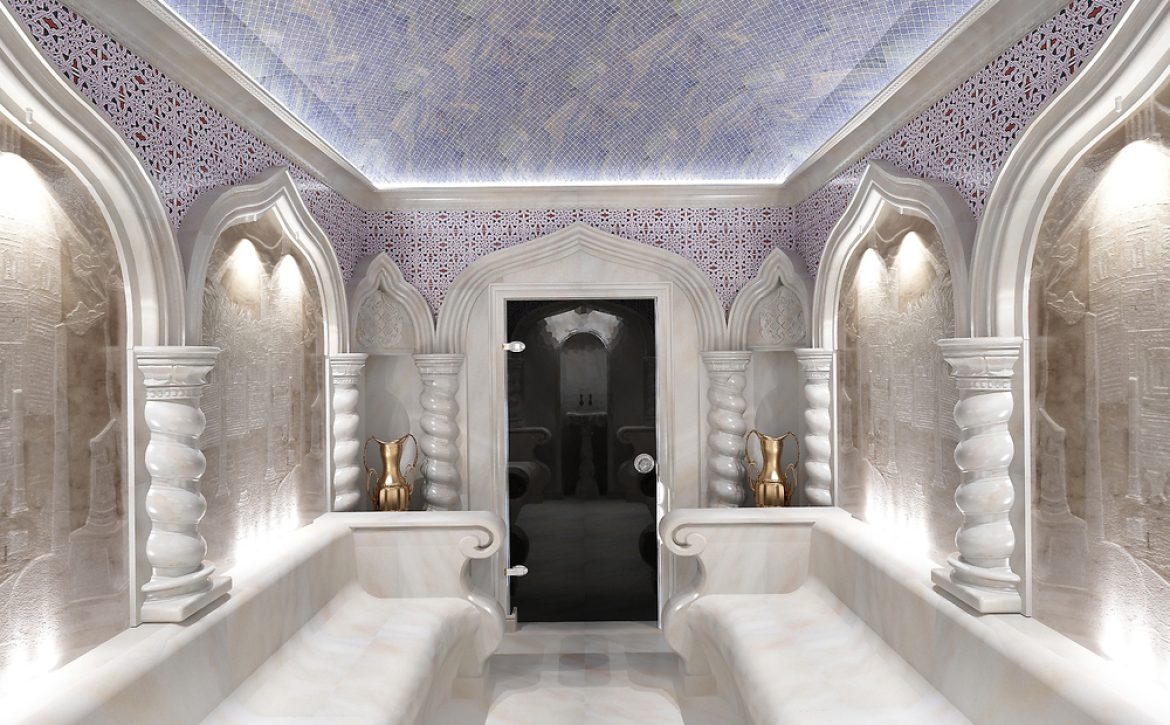
A traditional Turkish bath is defined by a dome, ornaments, marble basins and carved panels. Luxury hamam interiors in this style call for stonework details made in the workshop both by hand and on CNC machines. Stone hamam design can also be entirely contemporary, though: large-format slabs without ornament, indirect LED lighting and a single stone on the floor, walls and benches.

In many projects, stone spa design is not limited to the hamam itself. A relaxation zone, experience showers, a bathroom and sometimes a pool are combined into one whole. You will find inspiration in our projects of natural stone bathrooms, where we use similar materials and methods.

How much space you need

A small home hamam for two people can be built on as little as roughly 4 to 6 m². Larger spaces add a central platform and separate washing areas. The ceiling height should allow for a vault or at least a sloping ceiling. The steam generator is placed outside the bath, in a technical room or cabinet where it is easily accessible for servicing.

Think about how the rooms connect, too. The hamam door should be glazed and well sealed so that steam does not escape into other rooms. Ideally there is a shower and a rest area in front of the entrance, where the body can gradually cool down after the bath.

How we carry out the project

Every custom hamam starts with a consultation with the owner, architect and HVAC engineer. Together we determine dimensions, materials and the position of the technology. We then prepare production drawings, make the platform, benches, cladding and basins, and coordinate the work with other trades. Stone hamam installation is carried out by our own team, because the precision of joints and falls directly affects how the bath works.

PREMIUM STONES builds stone hamams for private villas, hotels and wellness centres. Hamam Bratislava: the capital and its surroundings are our home region, but we work throughout Slovakia. You can find examples in the stone hamams and baths section.

The cost depends on the size of the space, the type of stone, the technology and the extent of decorative elements. We prepare an exact budget after a consultation and site visit. If you long for your own wellness area, contact PREMIUM STONES and we will design a hamam that will serve you for decades.
Back Camera
09.10.2026 by admin 0 Comments

Stone Pillars: From Classical Architecture to Modern Interiors

The column is one of the oldest architectural elements of all. Greek temples, Roman basilicas and Baroque palaces stood on stone and still look monumental today. In contemporary houses and hotels, however, a pillar does not have to be merely a quotation from history. It can carry a ceiling, divide an open space, highlight an entrance or become a sculpture of light made of translucent onyx. Here is how a stone pillar is designed, made and installed.

A short note on the classical orders

Classical architecture distinguishes several orders of columns. The Doric is the simplest, with a massive shaft and an undecorated capital. The Ionic is recognisable by its volutes – spiral scrolls on the capital. The Corinthian is the richest, with a capital made of acanthus leaves. A column consists of a base, a shaft and a capital; the shaft is often slightly swollen (entasis) and sometimes decorated with vertical grooves called flutes.

These rules are still used today, especially when restoring historic buildings and in interiors that follow the classical style. Architectural stone pillars built to these proportions look harmonious even when placed in a new building.

Load-bearing pillar or cladding?

When planning, it is important to decide whether the pillar is to carry a load or whether it is an aesthetic element. A solid pillar cut from a single block can carry a great deal of weight, but it requires structural calculations and a good foundation. In modern buildings we more often do the opposite: a reinforced concrete or steel core does the structural work and the stone clads it on all sides.

Cladding is lighter, quicker to install and makes it possible to use materials that would not work as load-bearing elements. Decorative stone pillars can also stand entirely on their own – adorning an entrance hall, a garden or a terrace without any structural function.

Choosing the material

Marble is the traditional choice for pillars. Marble pillars in white Carrara or creamy Botticino look festive and can be finely worked, including complex capitals. For exteriors and high-load areas, granite pillars are a better fit, as they resist frost, rain and impacts. Travertine brings a warm, Mediterranean character and combines beautifully with plaster and wood.

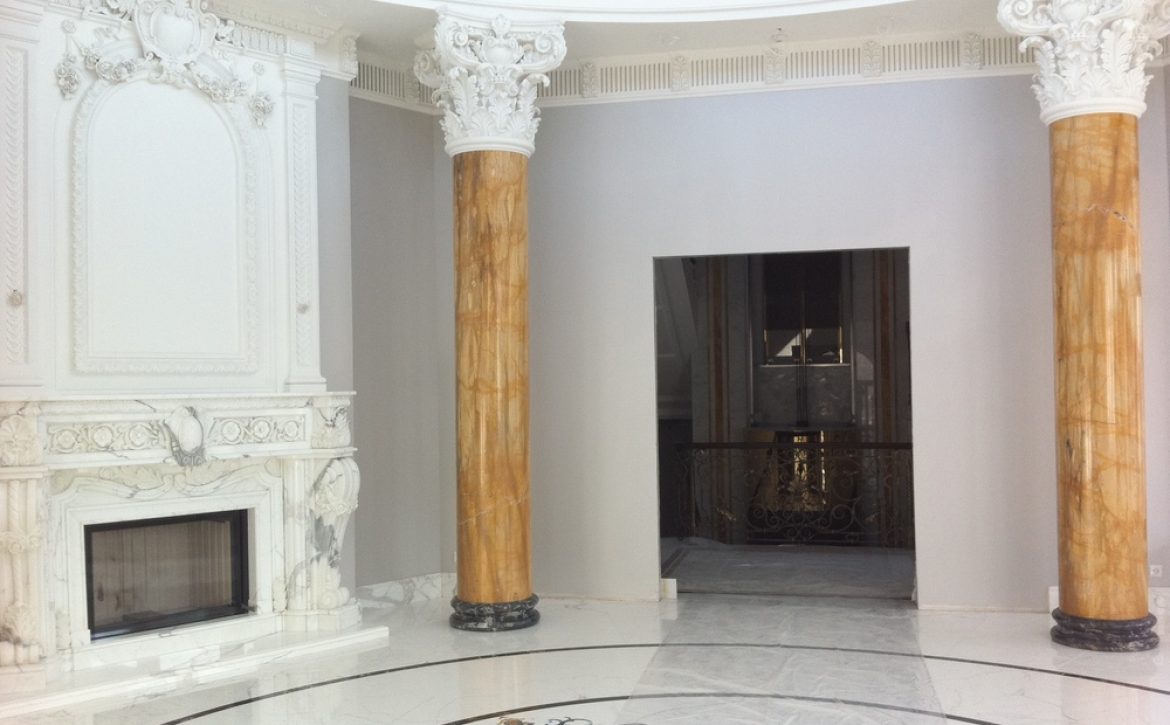
An interesting alternative for contemporary interiors is onyx. Lit from within, it becomes a light object that changes the atmosphere of the whole space. The veining matters too – we select natural stone for pillars so that the pattern continues around the entire circumference and the joints are not distracting.

How a pillar is made in the workshop

Production begins by cutting the block into prisms of the required size. A round shaft is turned on a CNC machine that can also create entasis or fluting with an accuracy of tenths of a millimetre. Square pillars are assembled from slabs with mitred corners, making the joint almost invisible.

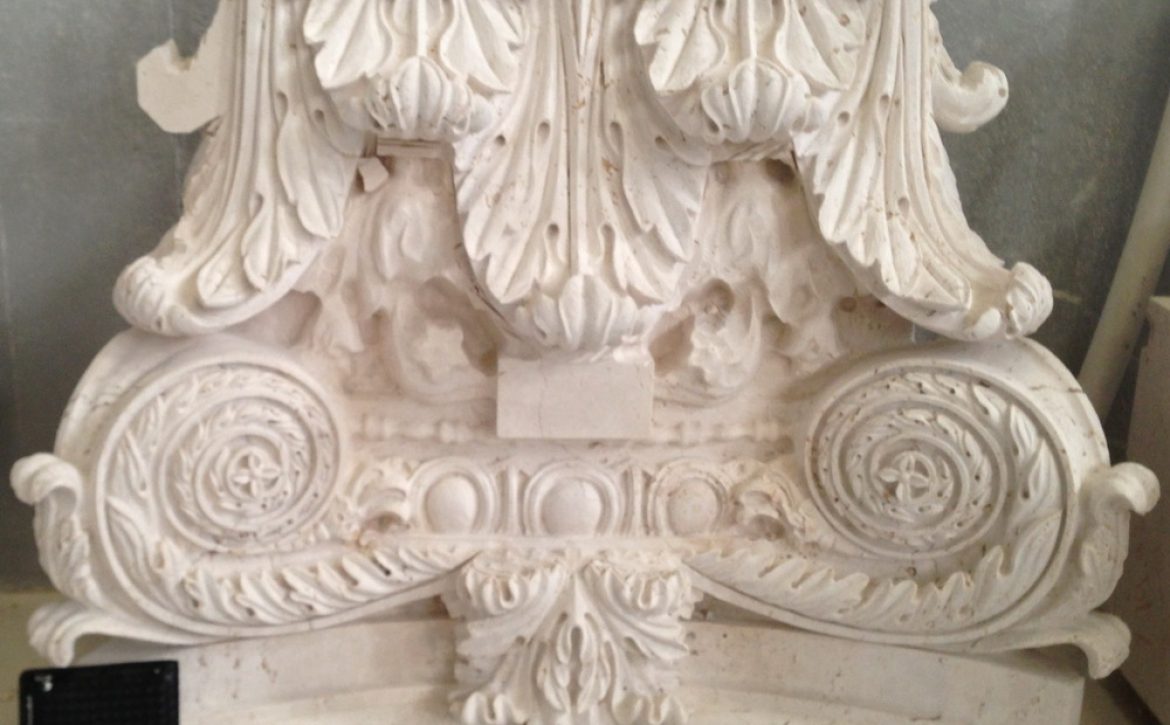
Capitals and bases are the most demanding part. Simple shapes are milled by machine, but ornate Corinthian capitals are finished by hand by a stone sculptor. We use similar techniques in stone carving, where reliefs, corbels and ornaments are created.

A modern pillar in a contemporary interior

In today’s homes, interior stone pillars often have neither a capital nor a base. They are clean cylinders or prisms of a single stone, repeated in a rhythm that completes the architecture of an open space. They work best in these spaces:

  • living rooms with high ceilings, where a pillar visually links floor and ceiling,
  • hotel lobbies and reception areas that need to look representative,
  • restaurants and wine bars, where pillars naturally separate individual zones,
  • entrance halls of villas with a gallery or an open staircase.

In such projects, stone pillar design follows the overall concept. A pillar can continue the material of the floor, contrast with the wall or conceal technical services. Integrated lighting or a combination of stone with brass and glass is also a frequent request.

Installation and cooperation

Pillars are installed in segments joined with stainless steel dowels and bonded with epoxy resin. Cladding is anchored to the core, and a gap is left between the stone and the concrete for expansion. For exterior pillars we also deal with water run-off from the capital and protecting the base from de-icing salt.

We make custom stone pillars to an architect’s drawing or to our own design after a site visit. PREMIUM STONES supplies natural stone pillars for private villas, hotels, sacred buildings and office buildings. Orders for stone pillars Bratislava clients place are handled including installation, but we also work in other regions and deliver stone pillars Slovakia-wide. You can see our projects in the stone pillars and colonnades section.

The cost depends on the type of stone, dimensions, type of capital, number of pieces and complexity of installation. We prepare an exact quote after a consultation. If you are planning an entrance, hall or terrace with pillars, contact PREMIUM STONES and we will design a solution that will stand for a hundred years.

09.10.2026 by admin 0 Comments

Stone Stairs for Interiors and Exteriors: Choosing the Stone and Surface Finish

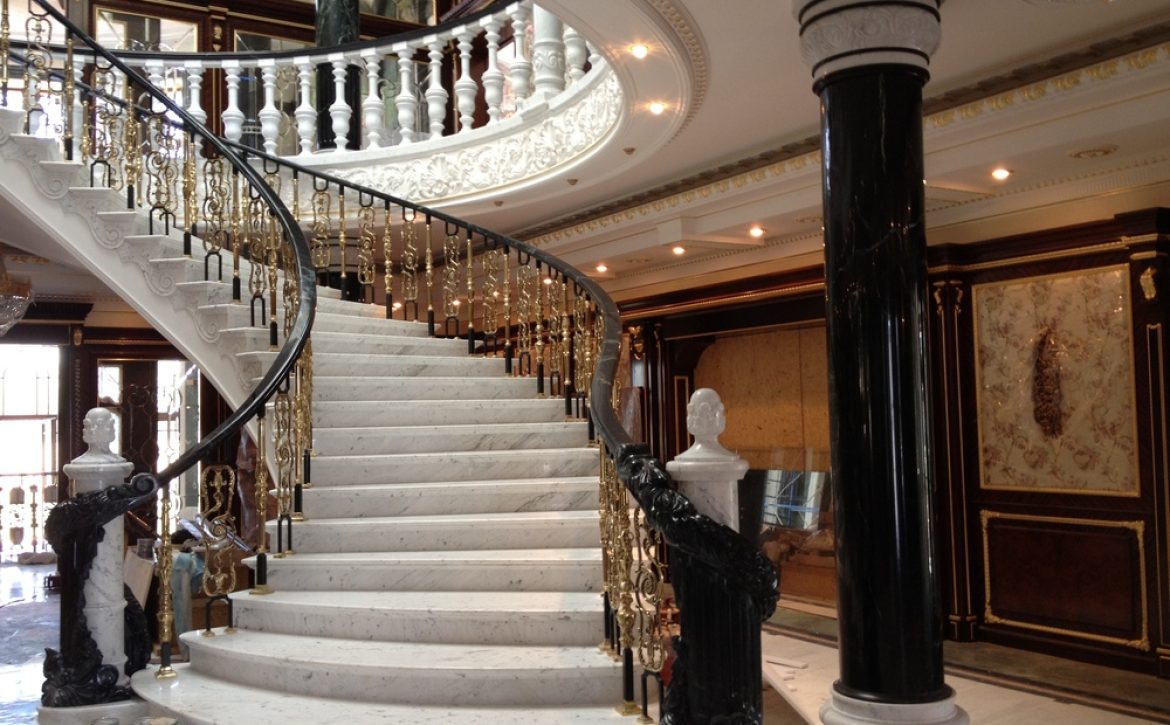
A staircase is one of the parts of a house we use several times a day, yet it is often planned at the very end. And it is precisely on stairs that you quickly see whether the material was chosen well. Stone here has to withstand thousands of footsteps, sand from shoes, water, frost and furniture being moved. With the right type and surface, it will last for generations without trouble.

Interiors and exteriors follow different rules

Inside the house, appearance, comfort and maintenance matter most. Outside, frost, rain, de-icing salt and sun come into play. While interior stone staircases can be polished and feature striking veining, an outdoor staircase needs stone with low absorption and an anti-slip surface.

For exteriors we therefore choose stone with proven frost resistance. Water that penetrates the pores and freezes in winter can gradually break the material down. Granite, quartzite and some dense limestones have no problem with this, while softer marble or unfilled travertine are riskier outdoors.

Which stone to choose

Every type has its strengths. When choosing, we consider where the staircase will be, how heavily it will be used and what character the house should have:

  • Marble – elegant and warm-looking, ideal for entrance halls and living areas,
  • Granite – very hard and durable, suitable for terraces, entrances and public buildings,
  • Travertine – natural and soft, with filled pores for interior use,
  • Quartzite – as hard as granite, but with veining reminiscent of marble.

In an entrance hall, marble staircases instantly elevate the whole interior, but bear in mind that a polished surface will show signs of foot traffic over time. In family homes we therefore often recommend a matt, honed finish. To see how the stone looks over a large area, take a look at our stone floors – stairs and flooring in the same material create a unified whole.

The surface finish decides safety

The same stone can be safe or dangerous on stairs depending on how it is finished. A polished surface is beautiful but slippery when wet. A honed (matt) surface is a good compromise indoors. Outdoors, flaming, sandblasting or bush-hammering are used to create a slightly rough texture.

For terraces and entrances the rule is simple: exterior granite stairs perform best with a flamed surface, which stays slip-resistant even in the rain. We can also mill anti-slip grooves into the front edges of the treads – they are discreet and add safety.

Dimensions, thicknesses and details

Walking comfort depends on the ratio between the height and depth of a step. A proven rule says that twice the riser height plus the tread depth should give roughly 63 centimetres. Treads are most often made 3 centimetres thick and risers 2 centimetres, with thicker slabs for exteriors and longer spans.

The edge is another detail that affects both looks and safety. Stone steps can have a straight, rounded or bevelled edge, or a nosing that overhangs the riser. For spiral and curved staircases each piece is made from a template, so custom stone staircases are the only way to achieve precise joints. Together with the stairs we also solve the landing, the skirting along the wall and the connection to the railing.

Installation without compromise

Even quality material loses its value if installed badly. Stone staircase installation starts with checking the concrete structure, its flatness and dimensions. Indoors the stone is bonded with flexible adhesive across the full surface, without voids that could cause cracking under load. Outdoors the treads are laid with a slight fall of 1 to 2 percent so that water does not stand on the surface, and frost-resistant adhesives and grouts are used.

Cantilevered stairs that seem to grow straight out of the wall need steel anchoring and a structural assessment. We recommend planning such a solution during the shell construction.

Maintaining a finished staircase is simple. The stone’s worst enemy is sand from shoes, which acts like sandpaper, so a doormat and regular vacuuming help. A neutral, acid-free cleaner is enough for washing. Every few years the surface is resealed, and worn polished marble can be reground to restore its original shine.

From design to finished staircase

We always design a staircase made of stone for the specific house. After a site visit we choose the material, prepare a drawing and, once approved, produce it in our own workshop. You choose the natural stone for stairs directly from the slabs in stock, so you know exactly what veining you will have at home.

PREMIUM STONES creates natural stone staircases for family houses, villas, hotels and office buildings. Stone staircases Bratislava clients order make up a large share of our work, but we install throughout Slovakia. You can see our projects in the stone staircases section.

The cost depends on the type of stone, number of steps, shape of the staircase, surface finish and complexity of installation. We prepare an exact quote after measuring. Contact PREMIUM STONES and we will design a staircase that will still be safe, comfortable and beautiful in thirty years.

09.10.2026 by admin 0 Comments

A Stone Fireplace in Your Interior: Marble, Granite or Travertine?

A fireplace is the natural heart of a living room. People gather around it, watch the flames, and their eyes keep returning to it even when there is no fire. That is why the choice of material deserves as much attention as the firebox itself. Stone gives a fireplace weight, calm and longevity, but every type behaves differently – with heat, with soot and with everyday cleaning. Let us look at how to choose between marble, granite and travertine.

What stone around a fireplace has to withstand

The area around the firebox is stressed differently from a kitchen top or a floor. The surround heats up from radiant warmth, sparks can land on it when the door is opened, and soot gradually settles above the opening. The firebox itself is lined with firebrick or fitted with a cast-iron insert, so the stone is not in direct contact with the flame. Even so, it needs stability under temperature changes and resistance to stains.

Weight matters too. A solid surround can weigh several hundred kilograms, so before installation we check the load-bearing capacity of the floor and the way it will be anchored to the wall. Thermal insulation goes between the insert and the stone, and ventilation grilles are left to let warm air escape.

Marble – a classic with striking veining

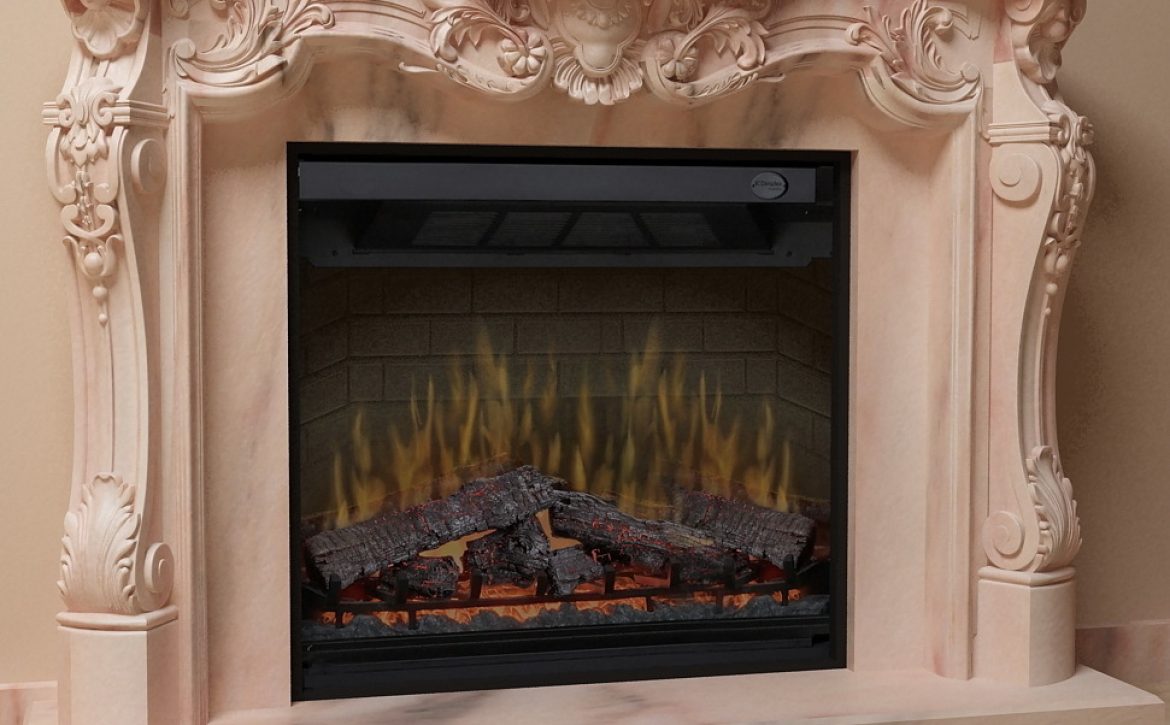
If you want the elegance of a château salon, a marble fireplace is a choice that never gets old. White Carrara, creamy Botticino or dark Nero Marquina create completely different moods. Marble is easy to work, so it is used for moulded mantels, corbels and fine ornaments.

It has weaker points, though. It is softer and sensitive to acids, so we seal it after installation and recommend cleaning it with mild products without vinegar or lemon. A polished surface shows every fingerprint, while a matt (honed) one is more practical in daily life. You can browse slabs in our selection of marble from Italy and other quarries.

Granite – durability comes first

Where the fire is lit often and burns hot, a granite fireplace is the right call. Granite is hard, has low absorption and copes well with temperature swings. Soot wipes off easily and the surface keeps its shine for a long time. Dark shades such as Absolute Black look modern and contrasting, while lighter fine-grained granites suit Scandinavian and natural interiors.

Granite is less suited to complex sculptural details; it is more about clean lines, large surfaces and precise edges. This makes it popular in minimalist projects.

Travertine – warm and natural

Travertine feels soft, warm and slightly Mediterranean. Its typical pores are filled for interior use so that soot and dust do not collect in them. It fits country houses as well as contemporary interiors with wood, clay plaster and linen. Travertine needs thorough sealing and regular but simple maintenance.

When choosing the shade, think about the floor and walls too. A fireplace in the same stone as the flooring feels like a natural part of the architecture, while a contrasting material turns it into a standalone object. Both approaches work – it depends on whether the fireplace should dominate the room or blend into it.

Surround, cladding or a whole wall?

Not every fireplace needs a classic surround – natural stone fireplaces can take many forms. When choosing a solution, we consider the style of the room, the size of the opening and the type of fire:

  • a stone fireplace surround with a mantel that creates a strong period accent,
  • stone fireplace cladding in simple large-format slabs without mouldings,
  • cladding of the entire wall from floor to ceiling, linking the fireplace with the TV or shelves,
  • a low stone bench in front of the firebox for sitting or storing logs.

In contemporary interiors, modern stone fireplaces often combine large slabs with hidden joints and veining that flows from one surface to the next. Stone fireplace design is therefore decided at the block selection stage, so that the pattern can be opened in a mirror image (bookmatch).

A fireplace made exactly for your space

A custom stone fireplace starts with measuring and choosing specific slabs. We prepare a drawing and agree with you on the edge profile, how it meets the wall and where the ventilation grilles go. We then process the natural stone for fireplace use in our workshop and install it on site so that insulation, anchoring and expansion gaps match the type of fire – wood, gas, bioethanol and electric fireplaces all have different requirements.

See our work in the stone fireplaces and surrounds section. PREMIUM STONES has its own workshop and fitting team, so we control production and installation from the first drawing to handover. A large share of our orders are stone fireplaces Bratislava homeowners commission, but we also work for more distant regions and deliver stone fireplaces Slovakia-wide to family houses, flats and mountain chalets.

The cost depends on the type and thickness of stone, the extent of cladding, the mouldings and the complexity of installation. We prepare an exact quote after a consultation. If you are planning a fireplace that will last for generations, contact PREMIUM STONES and together we will choose a stone that suits your home.

09.10.2026 by admin 0 Comments

Stone Masonry Bratislava: How to Choose a Stonemason for Your Project

A stone worktop, staircase or wall cladding will last for decades only if it is made by someone who understands both the material and the building. That is why nice photos on a website should never be the deciding factor. What matters more is how the workshop handles the stone, who takes the measurements, how installation is organised and who is responsible when something changes on site. Below we sum up what to check before you sign an order.

What stone masonry includes today

Many people still picture a stonemason as someone who makes gravestones. The trade has moved on a lot. Stone masonry Slovakia: in practice this means kitchen and bathroom tops, floors, staircases, facades, fireplaces, pillars and sculptural elements for private homes, hotels and churches. Each of these areas has its own technical demands. A kitchen top has to cope with hot pans and lemon juice, an outdoor step with frost and de-icing salt, facade cladding with wind and sun.

A good stonemason therefore does not start by asking which stone you like. First comes the question of where the product will be installed, how it will be used and who will maintain it. Only then does the specialist recommend a specific material, thickness and surface finish.

Own workshop or just a middleman?

The first thing worth finding out is whether the company does its own production. Stone fabrication Slovakia exists in two forms today: workshops with their own saws and CNC machines, and resellers who pass the job on. With the second option lead times get longer, and if something goes wrong, responsibility easily gets lost between several parties.

When a workshop owns its equipment, it also controls precision. Stone cutting Slovakia is one of the stages that decides the quality of joints, edges and cut-outs for the sink or hob. Stone slab fabrication likewise calls for experience in planning joints so that the veining of marble continues smoothly. Take a look at finished stone worktops and ask which of them the company actually made itself.

How to check a stonemason before ordering

At the first meeting it pays to have a few questions ready. The answers will tell you a lot about how the cooperation will go:

  • Can I see the actual block or slab my piece will be cut from?
  • Who measures on site, and when is the template made?
  • Is installation part of the order, or is it handled by another company?
  • What warranty applies to the product and to the installation?
  • How is the stone sealed and how should it be cared for?

A reliable stonemason Bratislava clients can trust will show you the warehouse, let you choose the slab and explain why a particular material is recommended. If someone avoids answering or only pushes the cheapest option, that is a reason to be careful.

It is also worth asking for references from similar projects. A kitchen top in a flat, a stone staircase in a family house and the cladding of a hotel reception each require different experience. If the company can show finished work you can visit, you will get a far better idea of quality than from any catalogue.

Installation decides the result

Even the most beautiful stone will not last if it is laid incorrectly. Installation of stone products requires a level and solid substrate, the right adhesives, expansion joints and sometimes mechanical anchoring. With walls and facades, weight and water drainage also have to be solved. Stone cladding installation Bratislava homeowners order also requires knowledge of local conditions, because older brick houses and new concrete buildings need different methods.

Ideally, one team handles both production and fitting. Stone fabrication and installation in one pair of hands means a single company is responsible for dimensions, joints and the final look, and you do not have to settle disputes between suppliers.

Material you can see in person

The choice is wide, and natural stone Bratislava suppliers offer comes in dozens of shades and finishes, yet a photograph never replaces looking at a real slab. Colour changes with light, and the veining varies even within one block. Before ordering, browse the catalogue of marble, granite, onyx and travertine and then view your chosen slab in person.

In our case, PREMIUM STONES keeps the whole process under one roof: from material selection through measuring and fabrication to installation. Thanks to this, we can offer custom stone Bratislava quality to more distant regions as well, without compromising on precision.

How the cooperation works

A project usually starts with a consultation and a site visit. Then come the design, slab selection, measuring and production. Lead time depends on complexity and on whether the material is in stock. Before you order stone products, make sure the scope of work, installation date and handover method are agreed in writing.

The cost depends on the type of stone, thickness, number of cut-outs, edge profile and complexity of installation. That is why we can give an exact figure only after measuring. If you are looking for trusted stone masonry Bratislava, contact us and we will arrange a consultation on your project.