

Stone Pillars: From Classical Architecture to Modern Interiors
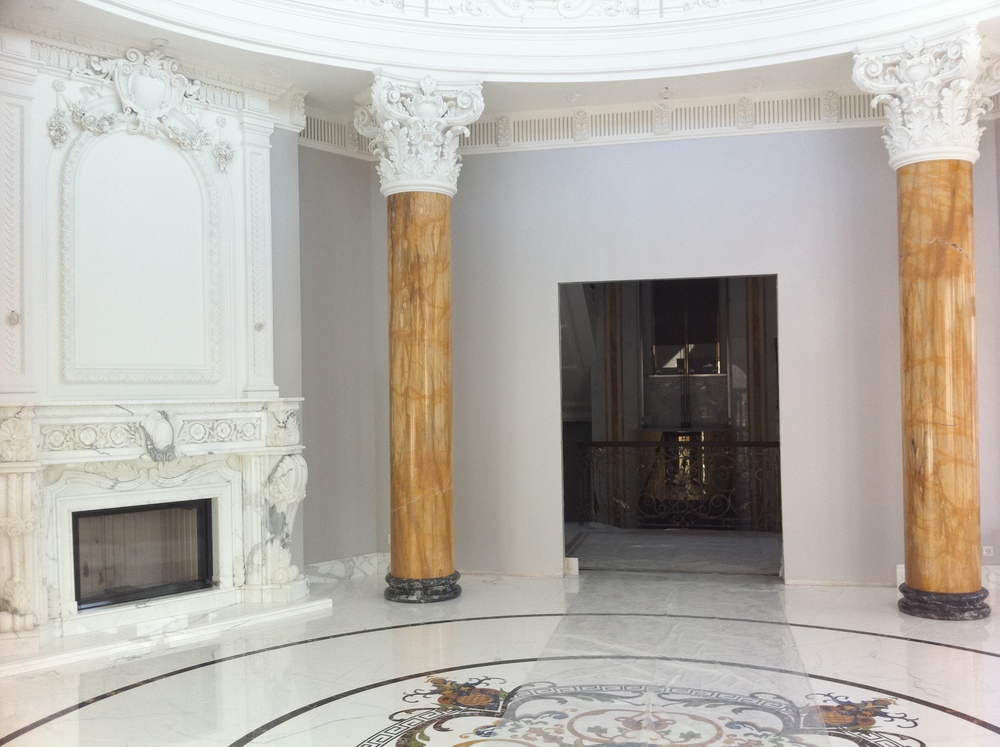
The column is one of the oldest architectural elements of all. Greek temples, Roman basilicas and Baroque palaces stood on stone and still look monumental today. In contemporary houses and hotels, however, a pillar does not have to be merely a quotation from history. It can carry a ceiling, divide an open space, highlight an entrance or become a sculpture of light made of translucent onyx. Here is how a stone pillar is designed, made and installed.
A short note on the classical orders
Classical architecture distinguishes several orders of columns. The Doric is the simplest, with a massive shaft and an undecorated capital. The Ionic is recognisable by its volutes – spiral scrolls on the capital. The Corinthian is the richest, with a capital made of acanthus leaves. A column consists of a base, a shaft and a capital; the shaft is often slightly swollen (entasis) and sometimes decorated with vertical grooves called flutes.
These rules are still used today, especially when restoring historic buildings and in interiors that follow the classical style. Architectural stone pillars built to these proportions look harmonious even when placed in a new building.
Load-bearing pillar or cladding?
When planning, it is important to decide whether the pillar is to carry a load or whether it is an aesthetic element. A solid pillar cut from a single block can carry a great deal of weight, but it requires structural calculations and a good foundation. In modern buildings we more often do the opposite: a reinforced concrete or steel core does the structural work and the stone clads it on all sides.
Cladding is lighter, quicker to install and makes it possible to use materials that would not work as load-bearing elements. Decorative stone pillars can also stand entirely on their own – adorning an entrance hall, a garden or a terrace without any structural function.
Choosing the material
Marble is the traditional choice for pillars. Marble pillars in white Carrara or creamy Botticino look festive and can be finely worked, including complex capitals. For exteriors and high-load areas, granite pillars are a better fit, as they resist frost, rain and impacts. Travertine brings a warm, Mediterranean character and combines beautifully with plaster and wood.
An interesting alternative for contemporary interiors is onyx. Lit from within, it becomes a light object that changes the atmosphere of the whole space. The veining matters too – we select natural stone for pillars so that the pattern continues around the entire circumference and the joints are not distracting.
How a pillar is made in the workshop
Production begins by cutting the block into prisms of the required size. A round shaft is turned on a CNC machine that can also create entasis or fluting with an accuracy of tenths of a millimetre. Square pillars are assembled from slabs with mitred corners, making the joint almost invisible.
Capitals and bases are the most demanding part. Simple shapes are milled by machine, but ornate Corinthian capitals are finished by hand by a stone sculptor. We use similar techniques in stone carving, where reliefs, corbels and ornaments are created.
A modern pillar in a contemporary interior
In today’s homes, interior stone pillars often have neither a capital nor a base. They are clean cylinders or prisms of a single stone, repeated in a rhythm that completes the architecture of an open space. They work best in these spaces:
- living rooms with high ceilings, where a pillar visually links floor and ceiling,
- hotel lobbies and reception areas that need to look representative,
- restaurants and wine bars, where pillars naturally separate individual zones,
- entrance halls of villas with a gallery or an open staircase.
In such projects, stone pillar design follows the overall concept. A pillar can continue the material of the floor, contrast with the wall or conceal technical services. Integrated lighting or a combination of stone with brass and glass is also a frequent request.
Installation and cooperation
Pillars are installed in segments joined with stainless steel dowels and bonded with epoxy resin. Cladding is anchored to the core, and a gap is left between the stone and the concrete for expansion. For exterior pillars we also deal with water run-off from the capital and protecting the base from de-icing salt.
We make custom stone pillars to an architect’s drawing or to our own design after a site visit. PREMIUM STONES supplies natural stone pillars for private villas, hotels, sacred buildings and office buildings. Orders for stone pillars Bratislava clients place are handled including installation, but we also work in other regions and deliver stone pillars Slovakia-wide. You can see our projects in the stone pillars and colonnades section.
The cost depends on the type of stone, dimensions, type of capital, number of pieces and complexity of installation. We prepare an exact quote after a consultation. If you are planning an entrance, hall or terrace with pillars, contact PREMIUM STONES and we will design a solution that will stand for a hundred years.