

Stone Stairs for Interiors and Exteriors: Choosing the Stone and Surface Finish
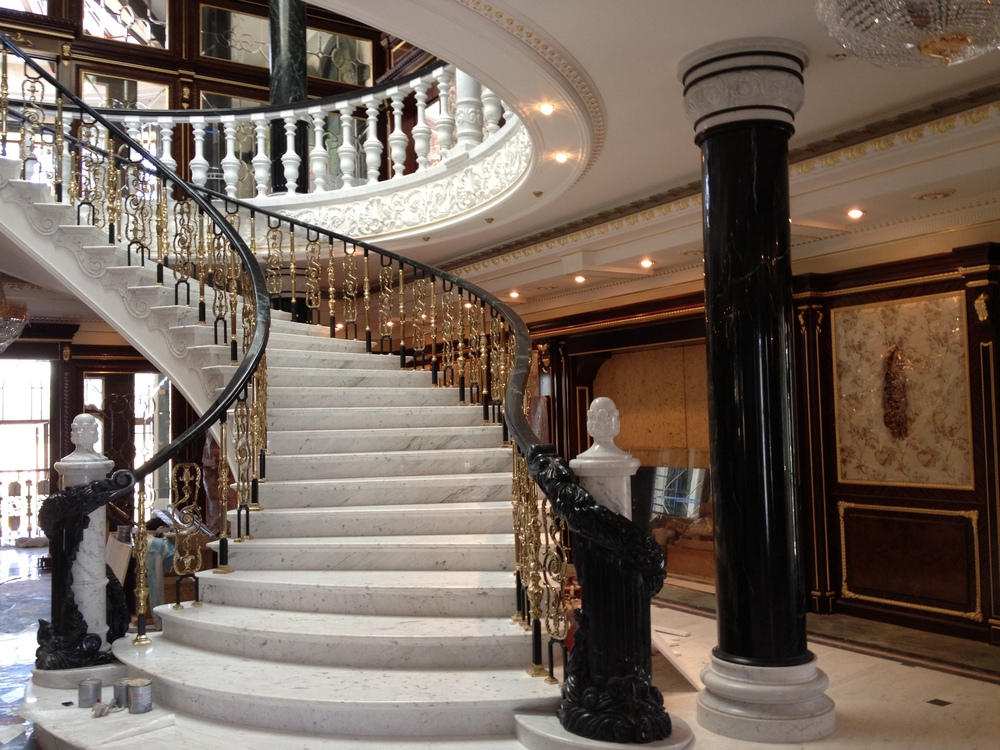
A staircase is one of the parts of a house we use several times a day, yet it is often planned at the very end. And it is precisely on stairs that you quickly see whether the material was chosen well. Stone here has to withstand thousands of footsteps, sand from shoes, water, frost and furniture being moved. With the right type and surface, it will last for generations without trouble.
Interiors and exteriors follow different rules
Inside the house, appearance, comfort and maintenance matter most. Outside, frost, rain, de-icing salt and sun come into play. While interior stone staircases can be polished and feature striking veining, an outdoor staircase needs stone with low absorption and an anti-slip surface.
For exteriors we therefore choose stone with proven frost resistance. Water that penetrates the pores and freezes in winter can gradually break the material down. Granite, quartzite and some dense limestones have no problem with this, while softer marble or unfilled travertine are riskier outdoors.
Which stone to choose
Every type has its strengths. When choosing, we consider where the staircase will be, how heavily it will be used and what character the house should have:
- Marble – elegant and warm-looking, ideal for entrance halls and living areas,
- Granite – very hard and durable, suitable for terraces, entrances and public buildings,
- Travertine – natural and soft, with filled pores for interior use,
- Quartzite – as hard as granite, but with veining reminiscent of marble.
In an entrance hall, marble staircases instantly elevate the whole interior, but bear in mind that a polished surface will show signs of foot traffic over time. In family homes we therefore often recommend a matt, honed finish. To see how the stone looks over a large area, take a look at our stone floors – stairs and flooring in the same material create a unified whole.
The surface finish decides safety
The same stone can be safe or dangerous on stairs depending on how it is finished. A polished surface is beautiful but slippery when wet. A honed (matt) surface is a good compromise indoors. Outdoors, flaming, sandblasting or bush-hammering are used to create a slightly rough texture.
For terraces and entrances the rule is simple: exterior granite stairs perform best with a flamed surface, which stays slip-resistant even in the rain. We can also mill anti-slip grooves into the front edges of the treads – they are discreet and add safety.
Dimensions, thicknesses and details
Walking comfort depends on the ratio between the height and depth of a step. A proven rule says that twice the riser height plus the tread depth should give roughly 63 centimetres. Treads are most often made 3 centimetres thick and risers 2 centimetres, with thicker slabs for exteriors and longer spans.
The edge is another detail that affects both looks and safety. Stone steps can have a straight, rounded or bevelled edge, or a nosing that overhangs the riser. For spiral and curved staircases each piece is made from a template, so custom stone staircases are the only way to achieve precise joints. Together with the stairs we also solve the landing, the skirting along the wall and the connection to the railing.
Installation without compromise
Even quality material loses its value if installed badly. Stone staircase installation starts with checking the concrete structure, its flatness and dimensions. Indoors the stone is bonded with flexible adhesive across the full surface, without voids that could cause cracking under load. Outdoors the treads are laid with a slight fall of 1 to 2 percent so that water does not stand on the surface, and frost-resistant adhesives and grouts are used.
Cantilevered stairs that seem to grow straight out of the wall need steel anchoring and a structural assessment. We recommend planning such a solution during the shell construction.
Maintaining a finished staircase is simple. The stone’s worst enemy is sand from shoes, which acts like sandpaper, so a doormat and regular vacuuming help. A neutral, acid-free cleaner is enough for washing. Every few years the surface is resealed, and worn polished marble can be reground to restore its original shine.
From design to finished staircase
We always design a staircase made of stone for the specific house. After a site visit we choose the material, prepare a drawing and, once approved, produce it in our own workshop. You choose the natural stone for stairs directly from the slabs in stock, so you know exactly what veining you will have at home.
PREMIUM STONES creates natural stone staircases for family houses, villas, hotels and office buildings. Stone staircases Bratislava clients order make up a large share of our work, but we install throughout Slovakia. You can see our projects in the stone staircases section.
The cost depends on the type of stone, number of steps, shape of the staircase, surface finish and complexity of installation. We prepare an exact quote after measuring. Contact PREMIUM STONES and we will design a staircase that will still be safe, comfortable and beautiful in thirty years.