

Natural Stone Hamam and Steam Room: How to Design a Home Wellness Area
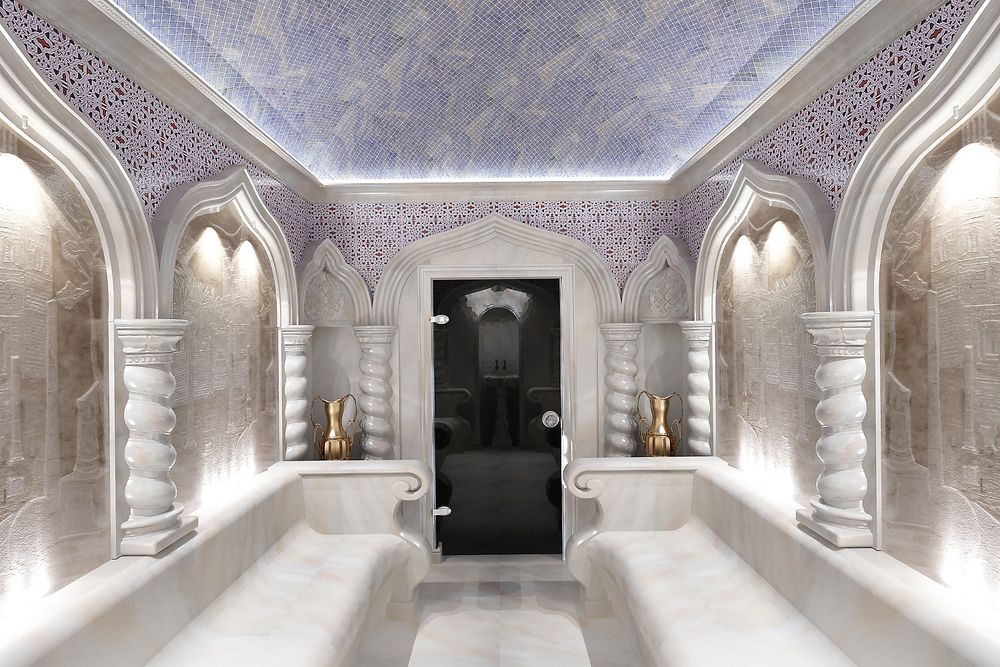
Home wellness is no longer a privilege of hotels. Owners of family houses and villas increasingly turn a basement or part of a bathroom into a space where they can relax in warmth and steam after a demanding day. The traditional oriental bath – the hamam – has the most atmosphere of all. But to work for years without mould, cracks and damp walls, it must be properly designed, from the insulation to the very last piece of stone. Here is what to keep in mind when planning a natural stone hamam in your own home.
How a hamam differs from a sauna
A Finnish sauna uses dry air and temperatures of around 80 to 100 °C. In a hamam the temperature is much lower, usually 40 to 50 °C, but humidity reaches almost 100 percent. The body warms up slowly, breathing is pleasant and a session can last longer. The heart of a hamam is a heated stone platform in the middle of the room, used for lying down or massage. Heated benches and basins for rinsing with water usually line the walls.
A stone sauna is a slightly different concept. Stone is used there as cladding behind the stove or as a thermal mass wall that holds heat for a long time. The best choice is soapstone, which does not deform at high temperatures and releases heat evenly.
Which stone for a warm and humid environment
Steam penetrates every joint and every pore. The stone must therefore be dense, with low absorption and resistant to repeated heating. A marble hamam is a classic – white and finely veined marbles bring purity and light to the space. We only choose dense varieties, however, and floors get a matt, anti-slip finish, because polished marble is dangerous when wet.
Quartzite and granite are even more resistant and work well for floors and benches. Travertine is used in a steam room only with filled pores and thorough sealing. We always select natural stone for wellness and spa according to its specific use – a floor walked on barefoot has different demands from a ceiling where steam condenses.
Technology you cannot see, but which decides everything
A hamam’s beauty is on the surface, but its lifespan depends on what lies beneath the stone. Without proper technical preparation, even the most expensive marble cannot keep out moisture. In the design we focus above all on:
- thermal insulation of walls and ceiling so that steam does not condense on cold surfaces,
- complete waterproofing and a vapour barrier, including corners and penetrations,
- underfloor and bench heating that keeps the stone pleasantly warm,
- a vaulted or sloping ceiling so condensation runs down the walls rather than dripping on your head,
- a floor falling towards the drain and powerful ventilation after the bath.
A stone steam room also needs the right adhesives and grouts. We use epoxy and flexible materials designed for permanently humid environments, which do not crack with temperature changes.
Design: from oriental classic to minimalism
A traditional Turkish bath is defined by a dome, ornaments, marble basins and carved panels. Luxury hamam interiors in this style call for stonework details made in the workshop both by hand and on CNC machines. Stone hamam design can also be entirely contemporary, though: large-format slabs without ornament, indirect LED lighting and a single stone on the floor, walls and benches.
In many projects, stone spa design is not limited to the hamam itself. A relaxation zone, experience showers, a bathroom and sometimes a pool are combined into one whole. You will find inspiration in our projects of natural stone bathrooms, where we use similar materials and methods.
How much space you need
A small home hamam for two people can be built on as little as roughly 4 to 6 m². Larger spaces add a central platform and separate washing areas. The ceiling height should allow for a vault or at least a sloping ceiling. The steam generator is placed outside the bath, in a technical room or cabinet where it is easily accessible for servicing.
Think about how the rooms connect, too. The hamam door should be glazed and well sealed so that steam does not escape into other rooms. Ideally there is a shower and a rest area in front of the entrance, where the body can gradually cool down after the bath.
How we carry out the project
Every custom hamam starts with a consultation with the owner, architect and HVAC engineer. Together we determine dimensions, materials and the position of the technology. We then prepare production drawings, make the platform, benches, cladding and basins, and coordinate the work with other trades. Stone hamam installation is carried out by our own team, because the precision of joints and falls directly affects how the bath works.
PREMIUM STONES builds stone hamams for private villas, hotels and wellness centres. Hamam Bratislava: the capital and its surroundings are our home region, but we work throughout Slovakia. You can find examples in the stone hamams and baths section.
The cost depends on the size of the space, the type of stone, the technology and the extent of decorative elements. We prepare an exact budget after a consultation and site visit. If you long for your own wellness area, contact PREMIUM STONES and we will design a hamam that will serve you for decades.